A quick orientation
An anal fissure is a small split in the thin lining of the anal canal, usually associated with pain during or after passing stool. It can be intensely uncomfortable despite being physically small. Some people notice a little bright-red blood; others mainly notice pain. Although many recent anal fissures improve with conservative measures, persistent symptoms deserve an assessment. This article explains the usual clinical approach in detail.
What is an anal fissure?
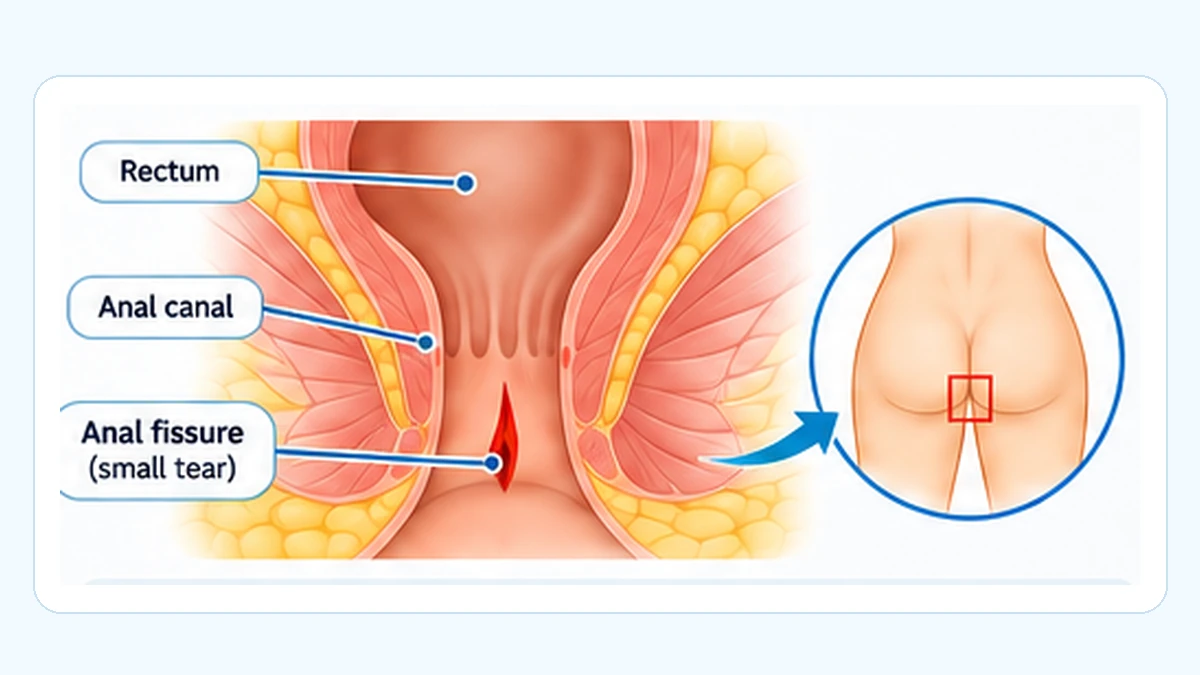
The anus is the opening at the end of the digestive tract. The anal canal is lined by sensitive tissue and surrounded by muscles that help control continence. A fissure is a tear or ulceration in that lining, typically located along the back (posterior midline) or, less often, the front (anterior midline). It is different from a hemorrhoid, which involves swollen vascular cushions, and from an abscess, which involves infection and a collection of pus.
Why does a small fissure hurt so much? The lining near the opening has many pain-sensitive nerves. A bowel movement may stretch the damaged area. In some people, the internal anal sphincter tightens in response to pain, reducing blood flow locally and making healing more difficult. This relationship between injury, spasm and impaired healing helps explain why treatment sometimes focuses on relaxing the sphincter rather than merely soothing the skin. [1, 4]
A fissure is not necessarily a sign of poor hygiene or a serious illness. However, an unusual location, multiple lesions, ongoing bleeding or symptoms that do not follow the familiar pattern may prompt investigation for an alternative diagnosis. A photograph or symptom list on the internet cannot settle those questions reliably.
Common symptoms and what they can mean
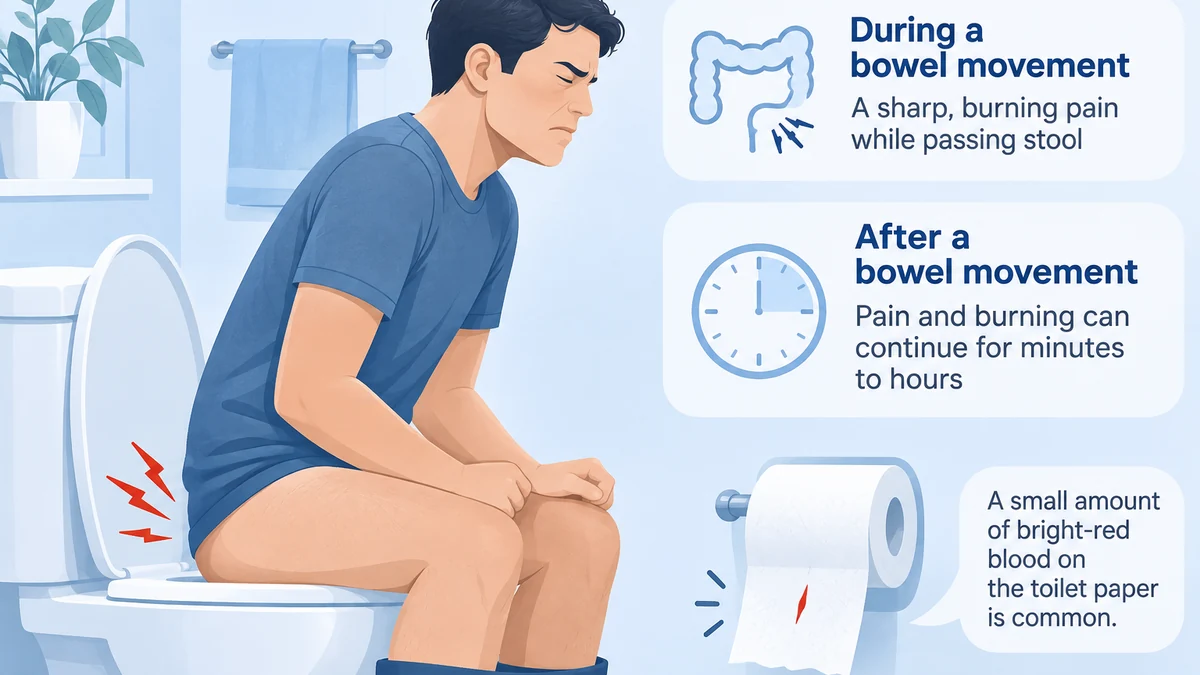
The classic description is sharp or tearing pain when passing stool, followed by a burning or aching sensation that may persist for minutes or hours. Some people describe becoming anxious before using the toilet because they expect pain. A small streak of fresh, bright-red blood may appear on toilet paper or the surface of the stool. Symptoms vary; a fissure can hurt without visible bleeding, and blood can appear without the characteristic severe pain. [2, 3]
A familiar pattern can suggest a fissure, but it does not prove one. Hemorrhoids, skin inflammation, infections and several less common conditions may produce overlapping symptoms. Blood that is dark, mixed through the stool, accompanied by a change in bowel habits or repeated without an obvious explanation should not simply be attributed to a fissure. Similarly, a new lump, spreading redness or fever changes the urgency of assessment.
Pain itself can affect bowel habits. People sometimes avoid going to the toilet and unintentionally become more constipated, making the next bowel movement harder. A practical aim of conservative treatment is to interrupt this cycle through comfortably soft stool and less straining. That is different from trying to suppress bowel movements or repeatedly applying untested products to a painful area.
Acute versus chronic fissures
Clinicians often distinguish a more recent, acute fissure from a longer-standing, chronic fissure. Definitions vary slightly across guidelines, but symptoms lasting more than about six weeks often lead to the chronic category. Duration matters because recent fissures commonly heal with stool management and other non-operative care, while persistent fissures may require medicines directed at sphincter relaxation or a specialist assessment. [1, 4]
Long-standing fissures can also show recognizable physical changes, such as thicker edges, exposed muscle fibers or a small external skin tag sometimes called a sentinel tag. These are clinical observations, not features a person should try to inspect painfully or infer from a non-professional photograph. A chronic lesion is not necessarily dangerous, but it can be stubborn.
The distinction is not a stopwatch that dictates one treatment for everybody. A person with persistent bleeding, severe symptoms, another medical condition or an atypical appearance may need assessment much sooner. Conversely, a clinician might recommend continued conservative measures while monitoring a clearly diagnosed fissure that is already improving. Decisions depend on the whole situation rather than a single number of days.
Causes and contributing factors
Fissures often follow mechanical stress on the anal lining. Hard, bulky stool and straining are common contributors. Repeated diarrhea can also irritate or traumatize the area. Pregnancy and childbirth may be relevant in some patients. In others, there is no single identifiable triggering event. Conditions such as Crohn’s disease can be associated with fissure-like lesions, particularly when the appearance or location is unusual. [1–3]
Constipation is not simply a question of eating enough vegetables. Stool consistency may be influenced by diet, fluid intake, medication, bowel routines, activity, illness and an individual’s usual pattern. For example, certain medicines may worsen constipation, while diarrhea-inducing products can make irritation worse. A clinician or pharmacist can help identify contributing medicines and appropriate adjustments.
An important practical point is that aggressive cleaning is not a treatment for a tear. Harsh soaps, perfumed wipes and repeated rubbing may irritate already sensitive skin. Gentle cleaning and patting dry are generally more sensible. Avoid applying strong antiseptics, anesthetics or mixtures to broken skin without checking their suitability, especially in people with sensitivities, pregnancy, complex disease or previous adverse reactions.
What else could cause pain or bleeding?
Hemorrhoids are enlarged or symptomatic vascular cushions inside or around the anus. They can cause bright-red bleeding, itching, a feeling of fullness or a protruding lump. Painful thrombosed external hemorrhoids can be particularly uncomfortable. Unlike a fissure, internal hemorrhoids often bleed with little pain, although real experiences overlap. Hemorrhoids and fissures can also exist together, so finding one problem does not automatically explain every symptom. [2, 5]
Perianal abscess is an infection that forms a collection of pus. It may cause more constant or throbbing pain, swelling, tenderness and sometimes fever or a feeling of being unwell. It can require urgent drainage; ointments are not a substitute. A fistula is an abnormal tunnel between the anal canal and nearby skin, sometimes following an abscess. Recurrent swelling or persistent discharge warrants medical evaluation. [5]
Dermatitis and irritation can cause soreness, itching and cracked skin around the anus. Allergic reactions, chronic moisture and excessive cleaning may be involved. Infections, including some sexually transmitted infections, can cause ulcers, inflammation, discharge or pain. These require a different diagnostic and treatment approach. Inflammatory bowel conditions, particularly Crohn’s disease, can produce atypical fissures or ulcers. Less commonly, persistent or unusual lesions raise concern for other pathology, including neoplasia. [1, 3]
Bleeding itself has many possible sources, including conditions higher in the digestive tract. The amount and appearance of blood, associated changes in bowel habit, weight loss, anemia, age, family history and other risk factors may influence whether a clinician recommends additional investigation. You should not assume bright-red blood is harmless just because a search result described a fissure. Equally, these possibilities do not mean that every episode indicates something serious.
The useful takeaway is not a checklist for self-diagnosis. It is an explanation of why persistent, recurrent, atypical or systemic symptoms need an examination even when a common fissure seems plausible. A professional can establish whether the problem is actually located in the anal canal and whether another condition requires attention.
How a clinician makes the diagnosis
Diagnosis usually begins with a history: when symptoms started, whether pain occurs during or after bowel movements, the nature of any bleeding, stool consistency, prior episodes, medicines and relevant health conditions. The clinician may gently inspect the area. A typical fissure may be visible without a painful internal examination. If the examination is too uncomfortable, it may be postponed or modified rather than forced. [1, 2]
Where findings are atypical or another condition is suspected, additional examination or tests may be appropriate. A clinician may consider anoscopy, further bowel investigation or specialist review according to the patient’s risk factors and the nature of the bleeding. This is individualized, not an automatic requirement for every straightforward case. Privacy and dignity are appropriate things to discuss before an examination; you can ask what will happen and why.
An internet article can explain terminology, but it cannot provide this assessment. If you have been treating a presumed fissure without improvement, the most useful next step may be confirmation of the diagnosis rather than adding another cream.
Conservative care: what can help at home
The foundations of conservative management are about reducing repeated trauma while the lining heals. A key aim is soft, formed stool that passes comfortably. A diet that includes adequate fiber can help many people, but sudden large increases may cause gas or discomfort. Change intake gradually and choose amounts that work with your bowel habits. Drink enough fluid to meet your needs; additional water is not a universal cure for constipation, and some people need medical advice about fluid restrictions. [1–3]
If constipation remains a problem, a pharmacist or clinician may recommend an appropriate stool-softening or laxative strategy. The right product depends on age, medical history, medications and whether the difficulty is hard stool, infrequent movements or something else. Using repeated stimulant products without considering the cause can create unnecessary problems. Persistent diarrhea also needs attention, because simply forcing softer stool is not helpful when stool is already loose.
Toilet habits matter. Respond to the urge to pass stool rather than delaying for a long time. Avoid pushing hard, holding your breath or sitting on the toilet for extended periods waiting for something to happen. Some people find a small footstool makes the position more comfortable, though that is a practical comfort measure rather than a proven cure. Try to keep the routine relaxed rather than turning every bowel movement into a prolonged procedure.
A warm, shallow bath after a bowel movement may ease discomfort. Use comfortably warm rather than hot water, and avoid adding irritating fragrances or harsh cleaners. Gentle washing and careful drying help protect the surrounding skin. For pain relief, a clinician or pharmacist can advise on suitable over-the-counter medicines, especially if you are pregnant, take other medication or have kidney, liver or stomach conditions. [2]
These steps have limitations. A person with an abscess, a different cause of bleeding, an unusual lesion or a chronic fissure with persistent spasm may not improve sufficiently through bowel habits alone. Pain that worsens, recurrent bleeding or a lack of improvement should shift the plan toward medical review rather than more experimentation with topical products.
Prescription topical medicines
For a chronic fissure, clinicians may prescribe medicines that lower resting pressure in the internal anal sphincter and improve blood flow to the injured area. These treatments are sometimes described as chemical sphincterotomy, because they aim for temporary relaxation without an operation. They are not simply interchangeable with protective ointments or homemade preparations. Choice, concentration and duration depend on local approvals and professional guidance. [1, 4]
Topical glyceryl trinitrate (nitroglycerin) is one option. It can improve healing for some people but often causes headaches, which may limit tolerability or cause treatment to stop. It may also lower blood pressure or interact with other medicines, including certain erectile-dysfunction treatments. Never combine it with contraindicated medications and do not borrow another person’s prescription. [1, 4]
Topical calcium-channel blockers, usually diltiazem or nifedipine in locally appropriate formulations, are another option. Professional guidelines find them broadly comparable to nitrates for healing chronic fissures and generally better tolerated with respect to headaches. They may still cause local irritation or other adverse effects; some preparations are compounded because availability differs by country. A clinician and pharmacist should determine whether such treatment is appropriate. [1, 4]
Topical treatment is not automatically the final answer. The diagnosis may be wrong, adherence may be difficult, side effects may be unacceptable or healing may fail despite an appropriate course. Those outcomes call for reassessment.
Injections, procedures and surgery
Botulinum toxin injection is sometimes offered for a chronic fissure. By temporarily weakening sphincter contraction, it can reduce pressure and allow healing. It may be used as an alternative to prescribed topical treatment or after that treatment has not worked. Effectiveness varies across studies, and it can occasionally cause transient problems with continence. The injection is a medical procedure, not something for home administration. [1, 4]
Lateral internal sphincterotomy is an operation that divides a controlled portion of the internal sphincter to lower resting pressure. It tends to have higher healing rates than medical treatment in selected chronic fissure patients. Yet it is not the right option for everyone: altered control of gas or stool is a significant risk to discuss, especially with previous sphincter injury, obstetric trauma, inflammatory bowel disease or earlier anal surgery. The precise technique and extent of division influence the balance of benefit and harm. [1, 4]
A specialist may discuss an advancement flap or other sphincter-preserving approach for selected patients in whom cutting the sphincter carries particular risk. Persistent or recurrent fissures deserve a fresh assessment of diagnosis, anatomy, bowel function, prior treatment and personal preferences before any procedure is chosen.
Discuss what a quoted healing percentage actually describes. Was it based on a particular chronic fissure population? Did it measure symptoms or a visibly healed lesion? How long were patients followed? Was altered continence actively assessed? These questions are more useful than treating one headline percentage as a promise for an individual patient.
Comparing outcomes and the quality of evidence
Published treatment outcomes depend on whether the fissure is acute or chronic, whether patients have had prior treatment, the method used to define healing and the length of follow-up. No treatment has an identical effect in every patient. The table summarizes established categories without implying that one approach is right for everyone.
| Approach | Evidence and reported outcome | Main considerations |
|---|---|---|
| Conservative measures for a recent fissure | Often sufficient for acute fissures; studies vary in definition and duration. No universal healing percentage is asserted here. [1–3] | Stool consistency, gradual fiber intake, warm baths; persistence requires review. |
| Topical nitroglycerin for chronic fissure | Guidelines find a healing benefit, but many patients do not heal; published estimates vary by trial and formulation. [1, 4] | Headache is common and may limit use; systemic contraindications matter. |
| Topical diltiazem / nifedipine | Broadly similar efficacy to nitrates, with a more favorable adverse-effect profile in reviews; preparation and trial methods differ. [1, 4] | May be compounded and may cause local irritation; clinician supervision required. |
| Botulinum toxin injection | Comparable to topical therapy as initial treatment in the ASCRS guideline; modest benefit in some second-line settings. [1, 4] | Variable protocols, temporary sphincter relaxation, possible transient incontinence. |
| Lateral internal sphincterotomy | ASCRS reports 88–100% healing in selected chronic-fissure surgical studies, with follow-up intervals up to six years. [1] | Reported fecal incontinence rates vary widely (8–30% across cited trials); selection and technique are critical. [1] |
| Our anal fissure ointment recipe | Natural ingredients that promote healing and reduce pain levels. Effective treatment at home for many recent anal fissure. Modest benefit for long-standing anal fissures. | Discuss suitability and irritation risks with a healthcare professional. |
A number taken from a surgical series is not a fair comparator for a newly diagnosed acute fissure; an adverse-effect figure collected at one follow-up visit may not describe long-term experience. Professional recommendations give an overview but do not eliminate uncertainty or the need for individualized care. [1, 4]
Prefer everything in one place?
Explore our PDF: foundational home-care information and the our anal fissure ointment preparation recipe, with materials, instructions and practical precautions.
When should you seek medical care?
Seek urgent assessment if anal pain is accompanied by fever, significant swelling, spreading redness or feeling seriously unwell, because an infection such as an abscess may require prompt treatment. Heavy or ongoing bleeding, faintness, weakness, black or tar-like stool, or other alarming symptoms also require urgent medical advice. Local emergency services are appropriate for severe or rapidly worsening symptoms. [2, 3, 5]
Arrange a non-urgent clinical assessment for bleeding that is new or unexplained, symptoms that worsen, recurrent fissures, an unusual mass or discharge, or symptoms that have not improved with appropriate self-care. The NHS advises contacting a GP if suspected fissure symptoms worsen or have not improved after seven days of home measures. This is a useful prompt, not a substitute for earlier care when red flags are present. [2]
People with inflammatory bowel disease, immune suppression, pregnancy, previous anorectal surgery or a history of sphincter problems may need a different risk assessment. The same applies to children and anyone who is unsure whether a change in bowel habits is significant. Do not use a paid guide, a blog or a self-prepared ointment to postpone necessary diagnosis.
Practical next steps and common questions
Can a fissure heal without surgery? Yes. Some recent fissures heal with conservative care. Chronic fissures may also respond to prescription ointments or injections, but persistent symptoms should be reassessed. Surgery is reserved for carefully selected situations and requires discussion of continence risks. [1, 2]
Is bright-red blood always a fissure? No. Hemorrhoids are a common alternative, but other conditions can cause bleeding. A clinical history and examination are important, especially when bleeding is persistent, unexplained or accompanied by other symptoms. [2, 3]
Should I stop using the toilet while it heals? No. Avoiding bowel movements can make constipation worse. Aim instead for comfortable stool consistency, unhurried habits and less straining. Seek professional advice if constipation or diarrhea continues despite reasonable measures.
Are natural or homemade ointments proven to heal fissures? While the word “natural” does not establish effectiveness or safety. Some ingredients may irritate the gentle skin or interact with other treatments. However, we believe that our recipe for anal fissure treatment at home is effective and suitable for most people, as it avoids common perianal skin irritants. When prepared correctly, our ointment can be a cheap and safe alternative to prescribed topical treatments.
What if a prescribed ointment does not work? In this case you should seek a clinician rather than extending treatment indefinitely. They may reassess the diagnosis, check for other causes, address bowel habits or discuss a different prescription or procedure.
What is a sensible first action? If the symptoms are new or uncertain, prioritize a warning-sign check and home treatment. For a diagnosed uncomplicated fissure, discuss stool-softening measures and appropriate comfort care. Record what changes, for how long, and whether bleeding or pain is improving.
Our guide to anal fissure treatment at home is intended as a discreet, personal reference for understanding common care principles. We believe that the described ointment preparation recipe is simple to make and effective treatment for many people. Still this guide does not replace medical advice, and it is not a clinical protocol validated for every reader. If an organized written reference would help you review the information, you can see the product and ordering details below.
A thoughtful reference to keep.
Learn what the digital guide includes, how external payment works, and when a personalized PDF is sent.
References and editorial note
This article summarizes established clinical information and published evidence. References reviewed for this draft on 9 November 2026. This is educational content, not personal medical advice.
- Davids JS, Hawkins AT, Bhama AR, et al. The American Society of Colon and Rectal Surgeons Clinical Practice Guidelines for the Management of Anal Fissures. Diseases of the Colon & Rectum. 2023;66(2):190–199.
- NHS. Anal fissure: symptoms, causes and treatment. Patient information, accessed 9 November 2026.
- American Society of Colon and Rectal Surgeons. Anal Fissure Expanded Information. Patient education.
- American Academy of Family Physicians. Management of Anal Fissures: Guidelines From the American Society of Colon and Rectal Surgeons. 2024 clinical-guideline summary.
- American Society of Colon and Rectal Surgeons. Abscess and Fistula Expanded Information. Patient information.